
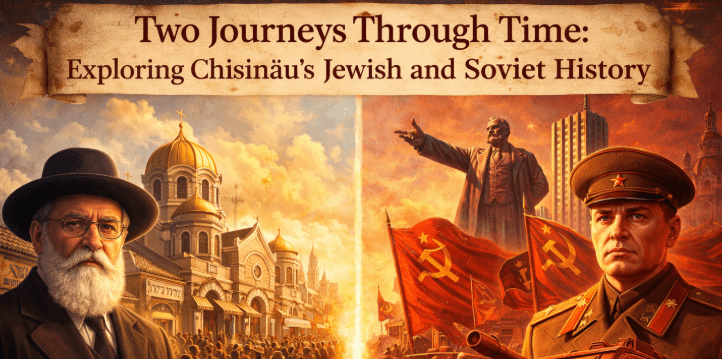
Chișinău is a city of layered histories, where grand boulevards and quiet cemeteries alike bear witness to the forces that shaped modern Moldova. For travelers seeking to understand this complex capital, two tours stand out as essential experiences: a Jewish Heritage tour tracing the rise and destruction of one of Eastern Europe’s most vibrant communities, and a soviet history tours moldova exploring life behind the Iron Curtain in a breakaway region that still honors Lenin. Together, they offer a complete portrait of Chișinău’s turbulent past.
Tour One: Jewish Heritage – Uncovering a Lost World
A Jewish heritage tour in Chișinău is a profound journey into the heart of a community that once comprised nearly half the city’s population. From approximately 10,500 Jews in 1847, the community swelled to over 50,000 by 1897—representing 46% of Chișinău’s residents . These were not merely numbers: they were scholars, merchants, artisans, and cultural leaders who built a rich network of synagogues, schools, and charitable institutions .
Your tour will begin with the historical context that made Chișinău synonymous with tragedy. Your guide will explain the 1903 pogrom, when anti-Semitic incitement led to three days of violence that left 49 Jews dead, over 500 injured, and 700 homes destroyed . A second pogrom in 1905 claimed 19 more lives . These atrocities inspired Hayim Nachman Bialik’s epic poem “In the City of Slaughter” and triggered waves of emigration that reshaped Jewish history .
The Jewish Cemetery is often the most haunting stop. Located in the Buiucani sector, this sprawling 12-hectare site contains an estimated 40,000 graves dating to the early 19th century . Unlike manicured Western cemeteries, this is a wild, overgrown place where vegetation has overtaken crumbling headstones . Among the ruins, you will find the memorial to the 1903 pogrom victims and the grave of Rabbi Leib Yehuda Tsirelson, the revered chief rabbi of Bessarabia who died during a 1944 bombing raid .
ou will also visit the Holocaust Memorial, where your guide will recount the horrors of July 1941. As German and Romanian units occupied Chișinău, approximately 10,000 Jews were massacred before the establishment of a ghetto. By the war’s end, roughly 90,000 Moldovan Jews had perished in concentration camps .
The tour concludes at the Choral Synagogue (Chabad Lubavitch) —not a museum but a living community hub where prayers continue . Depending on timing, you may witness services and meet members of today’s small but resilient community. Travelers consistently describe these tours as “sobering,” “poignant,” and among the most meaningful experiences in Chișinău .
Practical details: Tours last 3–4 hours, include hotel pickup, and require comfortable walking shoes . Guides like Natalia receive high praise for deep knowledge and careful planning .
Tour Two: Soviet History – Stepping into the USSR
A Soviet-era history tour offers something truly unique: the chance to step into a world that feels frozen in time. While Chișinău itself has largely shed its Soviet skin, the most immersive experiences take you just beyond the city limits into Transnistria—a breakaway region that still proudly displays the iconography and atmosphere of the USSR .
You will cross the Dniester River into a “country that doesn’t exist,” bringing your passport for the straightforward border checkpoint . Your destination is Tiraspol, Transnistria’s capital and the heart of the region’s Soviet preservation. Here, streets are lined with monumental Stalinist architecture, public squares are dominated by statues of Lenin, and the atmosphere feels decades removed from the present .
Key sites include:
The Suvorov Monument: Honoring the 18th-century Russian military commander
The Tank Monument: A memorial featuring Soviet military hardware
The House of Soviets: A prime example of Stalinist Empire architecture
Before reaching Tiraspol, most tours stop in Bender (Tighina) to explore the Bender Fortress, an Ottoman-era citadel layered with Soviet history . Along the Dniester River embankment, you will find Lenin monuments, brutalist mosaics, and the Tighina Military Cemetery honoring over 5,000 soldiers .
One of the most memorable moments is lunch at a traditional “Stolovaya” (Soviet canteen) , where you can sample classic red borscht, handmade cutlets, and sweet fruit “compot” served in vintage glassware . Many tours also include a stop at the KVINT distillery to sample the region’s world-renowned brandies .
Practical details: Tours last 6–8 hours, include hotel pickup, and require your passport for the Transnistria crossing . Guides like Marina and Ecaterina receive consistent praise for their impartial storytelling and deep historical knowledge .
Why Take Both?
Together, these tours offer a comprehensive understanding of Chișinău’s modern identity. The jewish heritage tours chisinau Moldova illuminates a multicultural past nearly erased by pogroms, the Holocaust, and Soviet oppression; the Soviet History tour explains how the regime operated, why Transnistria remains a relic, and how Moldova continues to navigate its post-Soviet identity. Whether you are a history enthusiast or a curious traveler, these journeys will transform your experience of Chișinău from sightseeing into genuine understanding.