

Picture the moment. You taxi back after a routine landing, your instructor says “stop here,” unbuckles, and steps out with a short word of encouragement. The door closes, and the seat beside you is empty. Your first solo flight has begun.
So how does an instructor decide it is time? In short, they send you when your flying is consistent, your corrections happen without prompting, and your training and paperwork are complete. Staying calm comes mostly from preparation: knowing the routine so well that the flight feels like a repeat of what you have already done many times.
This guide explains what instructors watch for, what the day usually looks like, and the habits that help student pilots keep their nerves under control.
What Do Instructors Look For Before a First Solo Flight?
Instructors look for three things: steady stick-and-rudder skill, sound judgment, and the ability to fix your own mistakes. Notice that none of these means being perfect. It means being predictable and safe.
Think of it as a trust test. Your instructor is asking, “If I stopped talking right now, would this pilot still bring the airplane home safely?” Every lesson in the weeks before solo is quietly collecting evidence for that answer.
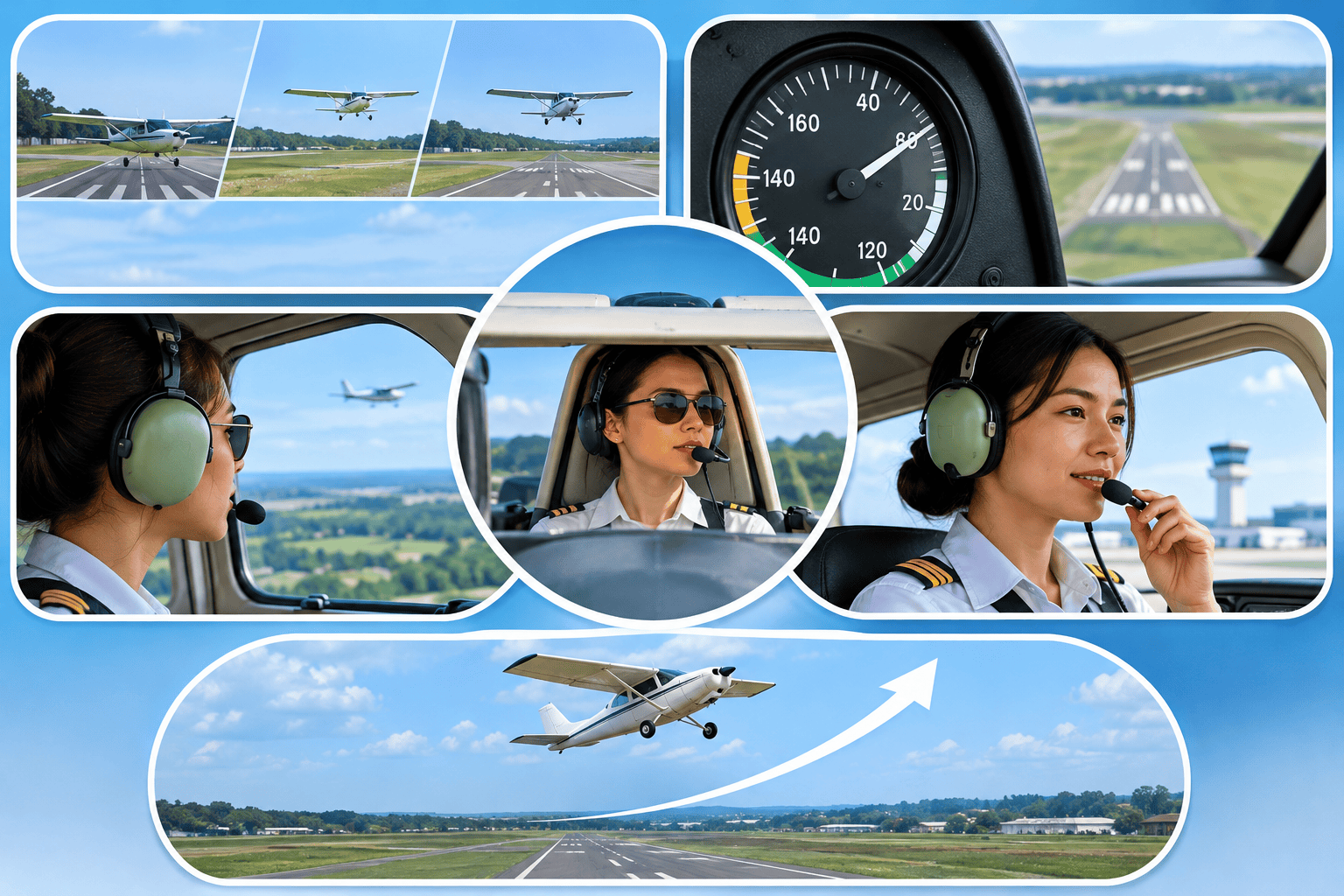
Here is what that evidence usually includes:
- Takeoffs, pattern flying and landings that turn out about the same each time
- Correct airspeed control on final approach
- A habit of looking outside for other aircraft
- Clear, calm radio calls at the airport
- A go-around flown correctly when an approach goes wrong
Consistency Matters More Than Perfection
Instructors care about repeatable results more than flawless ones. One veteran instructor, writing in AOPA’s Flight Training magazine, says he wants to see the airplane land in the right zone at the right speed, with the flare happening at about the same height each time. When he sees that three times in a row, after a history of similar results, he knows it is a solo day.
The same writer points out that new instructors sometimes expect too much from beginners. A student who is a few knots off the target speed but corrects promptly is showing the right habits. Safety comes from keeping margins and fixing small errors early, not from hitting every number exactly.
One of the best signs, he adds, is a go-around that the student starts without being told. It shows the student will act instead of freezing, and that is exactly what an instructor needs to see before stepping out of the cockpit.
The Training and Paperwork Behind the Decision
Readiness is not only a feeling. Before any student pilot flies alone, a set of rules has to be met, and the instructor is responsible for confirming them. The details are in 14 CFR 61.87, the FAA rule on solo requirements for student pilots.
In plain terms, the rule expects three things. First, you pass a knowledge test on the relevant regulations, the airspace around your airport, and the limits of the aircraft you will fly, and your instructor reviews every missed question with you. Second, you receive and log training in a list of required maneuvers and show satisfactory skill in them. Third, your instructor endorses your logbook for the specific aircraft make and model.
The rule also says the endorsement must be kept current. Because requirements can change, check the current text of the rule and ask your instructor how it applies to your situation.
Why There Is No Fixed Hour Count
Many students ask, “How many hours until I solo?” The honest answer is that it varies. There is no set number of lessons that guarantees it, and Flying Magazine’s guide to what students should know before solo notes that the first part of a syllabus follows the tasks the regulation lists for solo.
Weather, how often you fly, and how quickly the basics click all change the timeline. A student who flies often and studies between lessons may be ready sooner than one who flies once a month, and neither is behind. Schools also organize the early syllabus differently, so it helps to read how one lays out the sequence. As one example, a private pilot solo flight training outline shows solo flights listed as a milestone along the way, not a finish line.
Judgment: Can You Make a No-Go Call?
Skill alone is not enough. Instructors also want to see that you can decide not to fly. AvWeb’s series on pre-solo training explains that a solo pilot should have enough experience with preflight inspections and before-takeoff checks to notice when something is wrong, and enough confidence to make a no-go call or raise the problem with an instructor.
The same piece describes other pattern realities a first-time solo pilot has to handle, such as a wind shift while in the circuit and other airplanes flying wide downwind legs or long final approaches. Good judgment here is practical: look carefully, keep your options open, and speak up when something does not look right.
A student who says, “The crosswind feels beyond me today,” is showing the kind of thinking that earns trust. Instructors would much rather hear that than watch someone push past a limit to prove a point.
What the Day Usually Looks Like
Instructors rarely announce a solo in advance. Nobody can promise it will happen on a given lesson, because a bad day, gusty wind, or a distracted mind can all push it back. If you arrive and it does not happen, that is normal, and it says nothing about your future as a pilot.
When the day is right, the weather is usually calm, visibility and cloud height are comfortable, and there is plenty of fuel and daylight to spare. You fly a few circuits with your instructor first, so the routine feels familiar. Then your instructor asks you to stop, steps out, and says something simple. The AOPA author mentioned earlier tells students, “Just keep doing what you’ve been doing.”
Your instructor stays nearby and watches, often beside the runway, ready with a thumbs-up or a quick chat between landings. A typical first solo is a few takeoffs and full-stop landings in the traffic pattern, the pattern of rectangular legs around the runway used for takeoff and landing. Nothing new is added. You also have the right to say you are not ready; some students want to think it over, and a good instructor will simply try another day.
Calming Habits That Work
Nerves before a first solo flight are normal, and a little adrenaline can sharpen focus. The goal is not to remove nerves but to give them somewhere useful to go. These habits help.
Use a checklist for everything
A checklist gives your brain a script. When you feel rushed or anxious, reading the next item keeps you steady and prevents skipped steps. Treat it as a tool, not a crutch.
Brief yourself before you start
Many students find it helpful to spend a few minutes before engine start walking through the plan: which runway, how you will fly the pattern, where you will go if you need a go-around, and what your abort points are. Saying it out loud works well. A briefing turns vague worry into specific tasks.
Rehearse the pattern off the airplane
Sit somewhere quiet and picture each leg: takeoff, climb, crosswind, downwind, base, final, landing. Think about the radio calls and the speeds you will fly. Mental rehearsal builds the same familiarity that repeated flights do.
Slow your breathing
Before takeoff, take a few slow breaths. Long exhales calm the body and help you sound clear on the radio.
Plan for a bad landing
Student pilots often remember their first solo landing as imperfect. A bounce is fixable, and a go-around is always available. Decide ahead of time that you will go around whenever something feels off, and then do it without apology.
Remember what you already know
You have flown these circuits with your instructor many times. The solo flight is the same job with one fewer voice in the cockpit.
A Simple Pre-Solo Checklist for Students
Use this list in the days before the flight. It is a study aid, not a substitute for your instructor’s briefing.
- Review the airport diagram, runway layout and local traffic pattern procedures
- Rehearse your radio calls until they feel automatic
- Know the aircraft’s key speeds and your personal limits for wind
- Talk through your go-around plan and your emergency procedures
- Get a full night of sleep, eat a proper meal, and drink water
- Arrive early so you are not rushing through the preflight
Frequently Asked Questions
Is it normal to be scared before a first solo flight?
Yes. Nearly every pilot feels nervous before a first solo, including those who later become airline captains. Nerves usually mean you take the flight seriously. Preparation, checklists and a clear plan turn that energy into focus, and your instructor would not send you if they doubted your readiness.
Can I refuse to solo if I do not feel ready?
Yes. A student can say they are not ready, and a good instructor will respect that. Some students need more time to prepare mentally, and the lesson can simply be rescheduled. Talk openly with your instructor about what is worrying you so you can address it together.
What happens if my first solo landing is rough?
A rough landing is common and usually fixable. Bounces and uneven touchdowns happen to many first-time solo pilots. The right response is to stay calm, add power and go around if needed, or hold the airplane straight and complete the landing. Your instructor will review it with you afterward.
Does my instructor stay in contact during the solo flight?
Usually your instructor stays on the ground, nearby and visible, and says little over the radio unless something unexpected happens. The aim is for you to make the decisions yourself. Many instructors also check in briefly between landings with a calm word or a thumbs-up.
What requirements must be met before a first solo flight?
You must pass an instructor-administered knowledge test, log training in the required maneuvers, show satisfactory proficiency, and receive a logbook endorsement for the specific aircraft. Exact requirements are set by the FAA and can change, so confirm the current rules with your instructor and the FAA.
Take the Nerves With You
A first solo flight is less a test of bravery than a milestone your instructor has been building toward with every lesson. They are looking for steady skill, honest judgment and the ability to correct your own errors, and you can prepare for all three.
Spend your energy on the things you control: study the airport, rehearse the pattern, rely on your checklists and brief yourself before you start. When the day comes, remember that your instructor is only sending you because you have already shown you can do it. Fly the pattern you know, and enjoy the quiet.
Sources (for editor verification)
- Federal Aviation Administration (via eCFR), “14 CFR 61.87 – Solo requirements for student pilots” (2026) – https://www.ecfr.gov/current/title-14/chapter-I/subchapter-D/part-61/subpart-C/section-61.87
- AOPA Flight Training, LeRoy Cook, “When will I solo?” (2006) – https://www.aopa.org/news-and-media/all-news/2006/may/flight-training-magazine/when-will-i-solo
- Flying Magazine, Meg Godlewski, “The things you need to know before you solo” – https://www.flyingmag.com/the-things-you-need-to-know-before-you-solo/
- AvWeb, “Leading Edge #7: Fifteen Things” – https://avweb.com/features/leading-edge-7-fifteen-things/