
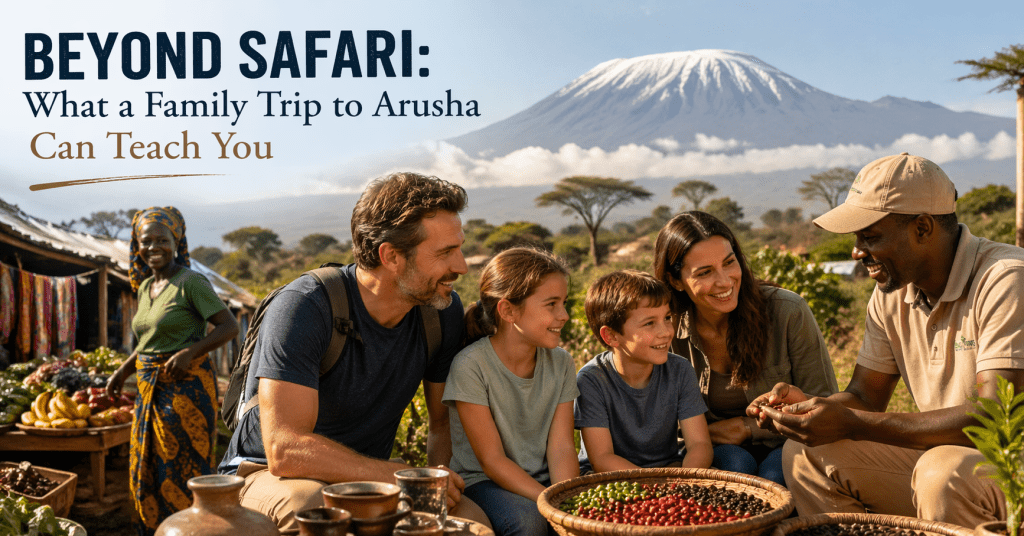
Most family trips to northern Tanzania begin with the big words. Safari. Serengeti. Ngorongoro. Kilimanjaro. You fly into Arusha with duffel bags, sun hats, and a mental slideshow already running ahead of you: elephants in the dust, lions in golden grass, the snow line on Mount Kilimanjaro, maybe a jeep at sunrise.
That trip is worth taking. The wildlife is extraordinary. The landscapes really do have that vast, cinematic quality people talk about. But if you are traveling with kids, there is another side of the Arusha area that can stay with them just as long, and maybe longer.
I keep thinking about The Small Things, a local organization whose cultural tours offer something different from the usual safari itinerary. Not instead of the national parks, exactly, but alongside them. A coffee tour. A market visit. Pottery. Village walks. A waterfall hike under banana trees. The kind of day many travelers might describe as a “break” between game drives. In practice, it can end up being the part of the trip that gives the rest of it some depth.
That is partly because The Small Things is not just running tours. The proceeds support its work with orphaned and vulnerable children and, more importantly, with keeping families together whenever possible. That family-first idea is central to the organization. On its website, TST makes the case clearly: poverty should not be the reason children grow up apart from their relatives.
That sounds simple, but it changes the way you think about what help actually looks like.
A lot of people still imagine orphan care in terms of buildings and rescue. TST’s model is much more grounded than that. It includes family preservation, case planning, business development support, counseling, nutrition and education support, preschool scholarships, and community banking.
And that is where a family visit can become more than a day trip.
If you are traveling with children from Europe or North America, especially kids used to stable homes, school runs, and everyday comforts, Tanzania can widen their frame of reference. Safari does that in one way. But spending time around Arusha with an organization focused on vulnerable children and family reunification opens a different kind of understanding.
Not a poverty lesson. Not the awkward kind where children are invited to stare at hardship. Instead, it becomes a conversation about family, opportunity, and real-life challenges.
That is one reason the cultural tourism side of TST makes sense. It allows families to experience local life respectfully. You might spend the morning learning how coffee moves from plant to cup or visit a pottery studio where the focus is on craft and creativity rather than storytelling for tourists.
Many travelers have also shared their experiences online, highlighting how meaningful and educational these tours can be. Children notice more than adults expect. They notice authenticity. They notice when a place feels real. And they notice when a trip is about more than just sightseeing.
A day like this does not come with dramatic safari moments. There is no lion sighting or grand wildlife scene. Instead, there are smaller, quieter experiences—the smell of coffee roasting, the feel of clay in your hands, the rhythm of a local market.
And sometimes, the most important moment comes later—when your child asks a question you didn’t expect.
Why can’t some children stay with their families?
That is where the real value of travel appears.
You get to explain that love is not always the missing piece. Sometimes it is resources—education, income, healthcare, or support systems. And that helping families stay together often requires long-term, practical solutions.
For a family on vacation, that can be a powerful realization. Not because it makes the trip heavier, but because it makes it more meaningful.
You may still go on safari the next morning. You should. Watch the giraffes move across the plains. Experience the beauty of Tanzania’s wildlife.
But if your trip also includes time with a local organization like The Small Things, your children may return home with something deeper than memories.
They return with perspective.
And that is a lesson worth packing into any family journey.